
Marine Electronics Have a Strange Definition of Obsolete
Why better marine systems integration could allow older and newer equipment to coexist instead of forcing unnecessary replacement during a boat refit.
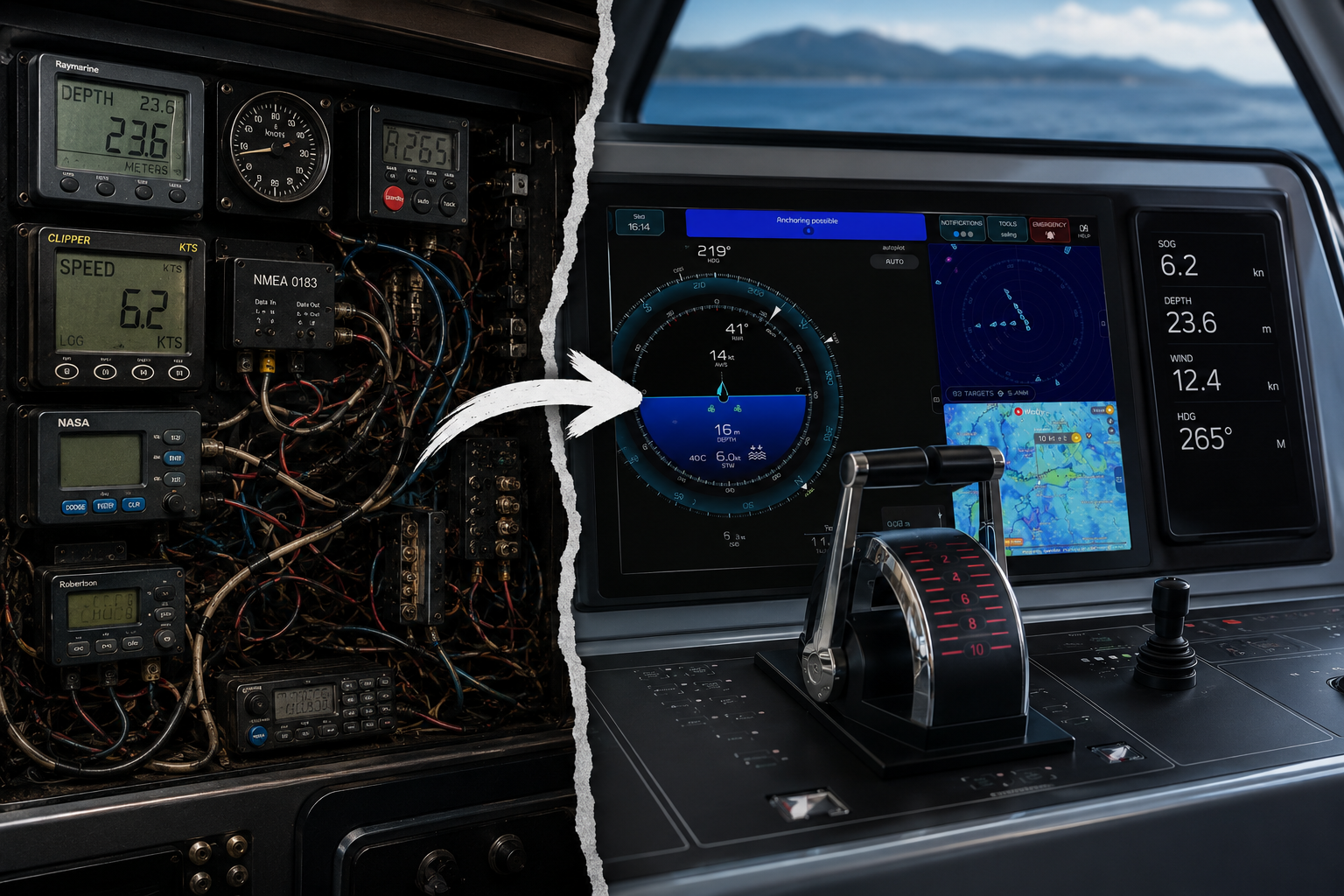
Sometimes equipment becomes obsolete because it stops working.
Sometimes it becomes obsolete because something significantly better replaces it.
And sometimes perfectly good equipment becomes “obsolete” simply because the newer equipment around it can no longer talk to it.
That third kind interests me.
Because boats have very long lives.
A well-built boat may still be operating fifty years from now. During that time, the electronics onboard will go through generation after generation.
Displays will change.
Networks will change.
Protocols will change.
Manufacturers will change direction, merge, disappear or stop supporting products.
But a surprising amount of the equipment itself may continue doing its job perfectly well.
A depth instrument doesn’t suddenly become bad at measuring depth because it’s twenty years old.
An engine doesn’t become obsolete because it doesn’t speak NMEA 2000.
A tank sender doesn’t stop knowing how much fuel is in the tank because the new display expects its information in a different format.
And a perfectly good radar doesn’t necessarily belong in the garbage because someone decided to modernize the helm.
Yet this happens all the time.
We start an electronics upgrade and very quickly discover that changing one thing means changing something else.
Then something else.
Eventually what started as replacing a display becomes replacing instruments, gateways, sensors, radar or other equipment that wasn’t actually broken in the first place.
There are legitimate reasons for replacing older equipment.
Reliability matters.
Parts availability matters.
Safety matters.
And sometimes newer technology provides enough additional capability that replacement is unquestionably the right decision.
I’m certainly not arguing that old equipment should be kept simply because it still turns on.
But age alone shouldn’t make that decision.
And integration shouldn’t make it for us either.
Because the equipment isn’t always obsolete.
Sometimes the architecture has simply stopped making room for it.
I think that’s an important distinction.
A real boat doesn’t exist at a single moment in technology.
It evolves.
An owner replaces an autopilot this year.
Adds lithium batteries two years later.
Changes the navigation system after that.
The engines might be fifteen years old.
The depth and wind instruments might be twenty.
A new solar installation may have been commissioned six months ago.
And there may be a watermaker, generator, cameras, tank sensors and switching systems from entirely different manufacturers and generations.
That’s not necessarily a badly designed boat.
That’s the normal lifecycle of a boat.
So perhaps our architecture should expect it.
Instead of designing around the assumption that everything onboard will always belong to the same generation, manufacturer or ecosystem, we could design around a much simpler assumption:
Boats change.
Equipment should be able to come and go without forcing everything around it to change too.
That means looking at older equipment differently.
The first question doesn’t necessarily need to be:
What protocol does it use?
Or:
Who manufactured it?
A more useful question might be:
What useful information does it have, and is there a sensible way to make that information available to the rest of the boat?
Sometimes the answer will be no.
Sometimes the cost and complexity of preserving something will exceed the value of keeping it.
Replace it.
But increasingly, there are ways to bridge generations of equipment without rebuilding everything around them.
And that changes the economics of a refit.
Instead of modernization being an event where the old boat is effectively stripped away and rebuilt around a new electronics ecosystem, it can become a progression.
Keep what works.
Connect what makes sense.
Replace what genuinely needs replacing.
Add new capabilities where they create value.
And allow the architecture underneath to absorb the differences.
There is something fundamentally wasteful about an architecture that turns functioning equipment into e-waste simply because the interface around it changed.
And I suspect this issue is going to become more important, not less.
Because the pace of technology development isn’t slowing down.
The equipment we install today will eventually become the “old equipment” somebody is trying to integrate ten or fifteen years from now.
Perhaps one measure of good architecture isn’t simply how well it accommodates today’s technology.
It’s how gracefully it accommodates tomorrow’s.
So maybe a good marine refit shouldn’t begin with:
What do we need to replace?
Maybe it should begin with:
What do we already have that’s worth keeping?
Then build the architecture around the answer.
For those of you doing refits and integrations every day, what perfectly good piece of equipment do you most often see replaced simply because it has become too difficult to integrate?