
Real Boats Are Messy. Their Technology Shouldn’t Have to Be.
Why marine systems integration should hide complexity from the boat owner, not make them responsible for solving it.
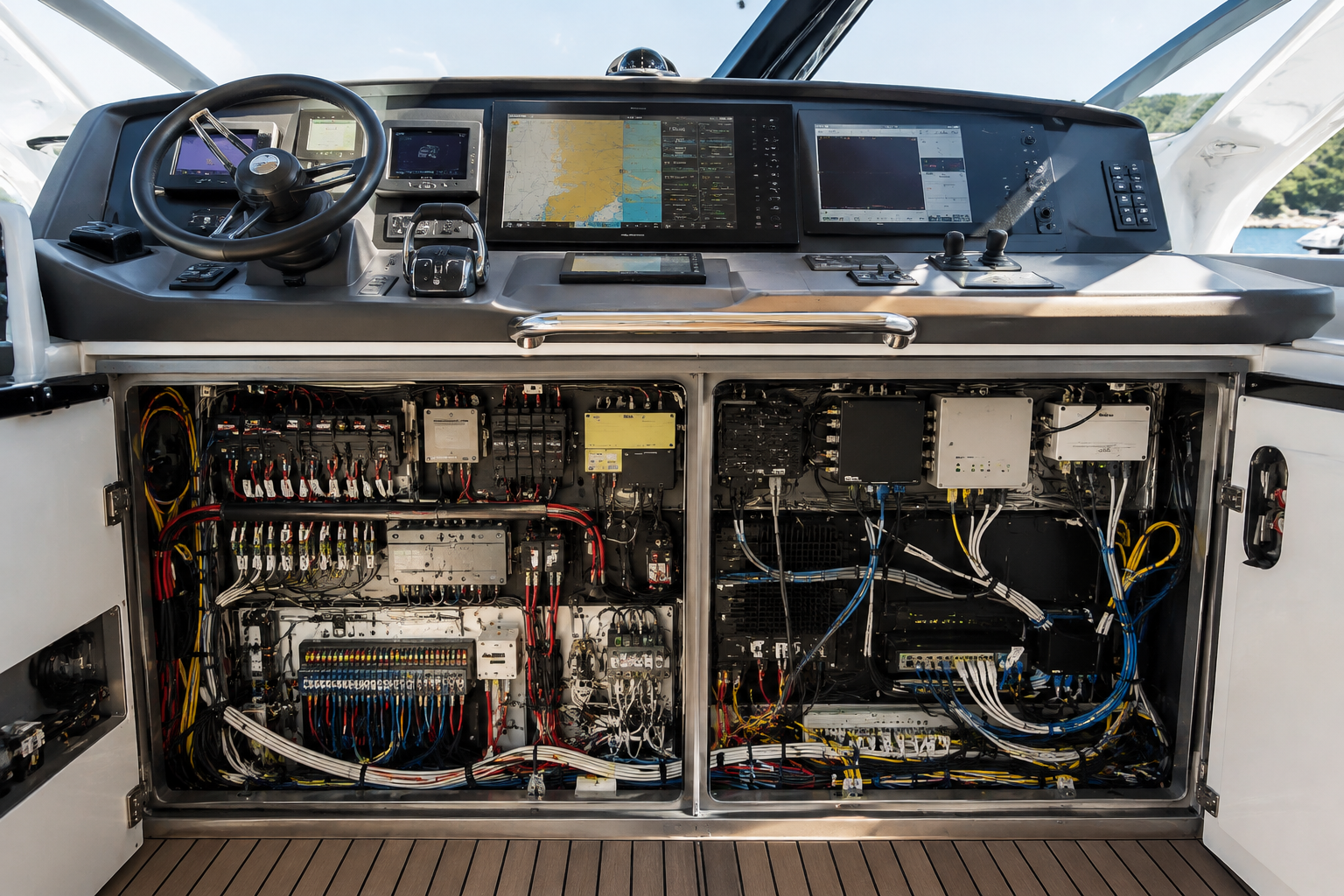
I had an interesting conversation this week that made me realize how differently people interpret the words “open architecture.”
To some people, open means open source.
To others, it means being able to install software on whatever hardware they choose.
And to some, it means having access to enough gateways, protocols and tools that, with enough time and technical knowledge, you can make almost anything talk to almost anything else.
All of those can be forms of openness.
But they’re not really what open architecture means to me.
To me, open architecture means your choices remain yours.
Real boats aren’t built from one manufacturer’s catalogue.
You might have Raymarine navigation, a Volvo engine, Victron power, CZone switching, a third-party watermaker, cameras from somewhere else and twenty-year-old instruments that still work perfectly well.
And increasingly, even when all of those systems are technically “connected,” that doesn’t necessarily mean their information is available to the rest of the boat.
Someone working on two new boat builds described what he was dealing with this week: YachtSense, EmpirBus, Quick, Victron, proprietary PGNs and equipment increasingly presenting information through HTML5 interfaces without necessarily providing convenient access to the underlying data.
His description was perfect:
“It’s a bit of a mess.”
It is.
And it isn’t just older boats.
These were new builds.
For decades, we’ve organized marine electronics around the MFD.
The MFD became the centre of the helm. If we wanted another capability, we asked whether it could run on the MFD. If we wanted information from another system, we asked whether the MFD manufacturer supported it.
That made perfect sense when the MFD was effectively the computer.
But modern computing doesn’t have to work that way.
The computer running the operating environment can be somewhere else entirely.
The display at the helm can simply be a window into it.
So can a tablet in the cockpit.
Or a large screen in the salon.
Or the phone in your hand when you’re standing in the engine room trying to figure out what’s going on.
They don’t have to be separate systems with separate versions of the truth.
They can all be different windows into the same operating environment.
And once you think about the boat that way, some interesting questions follow.
If I choose a Raymarine radar, why should that decision determine which power system I can see?
If I choose Victron for power, why should that determine which navigation equipment I can use?
If a perfectly good twenty-year-old instrument is still producing useful data, why should I replace it simply because the rest of the boat got newer?
The equipment should serve the boat. The boat shouldn’t have to serve the equipment ecosystem.
Of course, there is another way to achieve this kind of openness.
You can build the integration yourself.
There are excellent open-source projects, gateways, inexpensive computers and tools available today that allow a technically capable boat owner to connect an extraordinary amount of equipment.
And for some people, building that system is part of the enjoyment.
But there is a cost that rarely appears on the parts list.
Time.
Someone still has to understand the protocols.
Configure the gateways.
Deal with proprietary data.
Make the twenty-year-old instrument talk to the five-year-old power system and the brand-new navigation equipment.
Configure the software.
Maintain it.
Troubleshoot it.
And figure out why something that worked perfectly yesterday suddenly stopped communicating today.
You can absolutely do it.
The question is whether you should have to.
Because to me, the purpose of open architecture isn’t to transfer the integration problem from the manufacturer to the boat owner.
It’s the opposite.
The messy work should happen underneath, so you don’t have to deal with it.
Different manufacturers. Different generations. Different protocols. Proprietary data. Old equipment alongside new.
That’s our problem to solve.
What the person operating the boat should see is one coherent operating environment.
And that is where I think we sometimes confuse connectivity with integration.
Getting two devices to exchange data is connectivity.
Making that information useful alongside everything else happening on the boat is integration.
And making all of that complexity disappear from the person operating the boat is something else again.
That’s the part I find interesting.
Because integration isn’t really successful when everything can technically communicate.
It’s successful when the person operating the boat no longer has to care how it communicates.
That’s what open architecture means to me.
Not that every boat has to use the same equipment.
Not that everything has to come from the same manufacturer.
And certainly not that the owner should have to become a systems integrator.
Freedom to choose the equipment that is right for your boat, and still have the boat operate as one system.
Maybe the marine industry’s next interoperability challenge isn’t another standard.
Maybe it’s making all the standards, proprietary systems and generations of equipment we already have work together well enough that the complexity finally disappears.
For those of you working on real boats every day, where are you still finding the biggest interoperability headaches?