
Integration was Yesterday’s Problem
A few weeks ago, a shipyard contacted us with an unusual request.
One of their customer’s boats had just gone back into the water after a major refit. Everything appeared to be working, except for an intermittent GPS alarm that nobody could quite explain.
They asked if we could log into the boat and tell them which GPS was causing the problem.
It was such a simple question that I almost didn’t think twice about it.
Then it struck me.
Not long ago, the challenge would have been getting all of those systems to communicate in the first place. This time, nobody questioned whether they could. They assumed they could.
The question had changed.
They weren’t asking whether the boat was connected.
They were asking whether someone could make sense of what the connected systems were saying.
I haven’t stopped thinking about that.
For most of my career, integration was the hard problem.
In the enterprise software world, companies spent years connecting finance systems, manufacturing systems, customer systems and operations. Every successful integration was celebrated because it removed another information silo.
Marine technology has lived through much the same challenge. Different manufacturers. Different protocols. Different generations of equipment. Different philosophies about how information should be shared.
For years, connecting everything together felt like the finish line.
Lately, though, I’ve started to notice something different.
Over the past few months we’ve completed integrations that would have seemed ambitious only a few years ago. Modern APIs are becoming more common. Legacy systems are finding new ways to participate. Development tools are improving at an astonishing pace.
Real boats are still messy, and they always will be. Every installation has its own history. Every owner has made different decisions. Every vessel is a unique combination of old and new technology.
But despite that complexity, I find myself spending less time wondering whether systems can be connected.
Instead, I’m asking a different question.
Once everything is connected, how do we help people understand what actually matters?
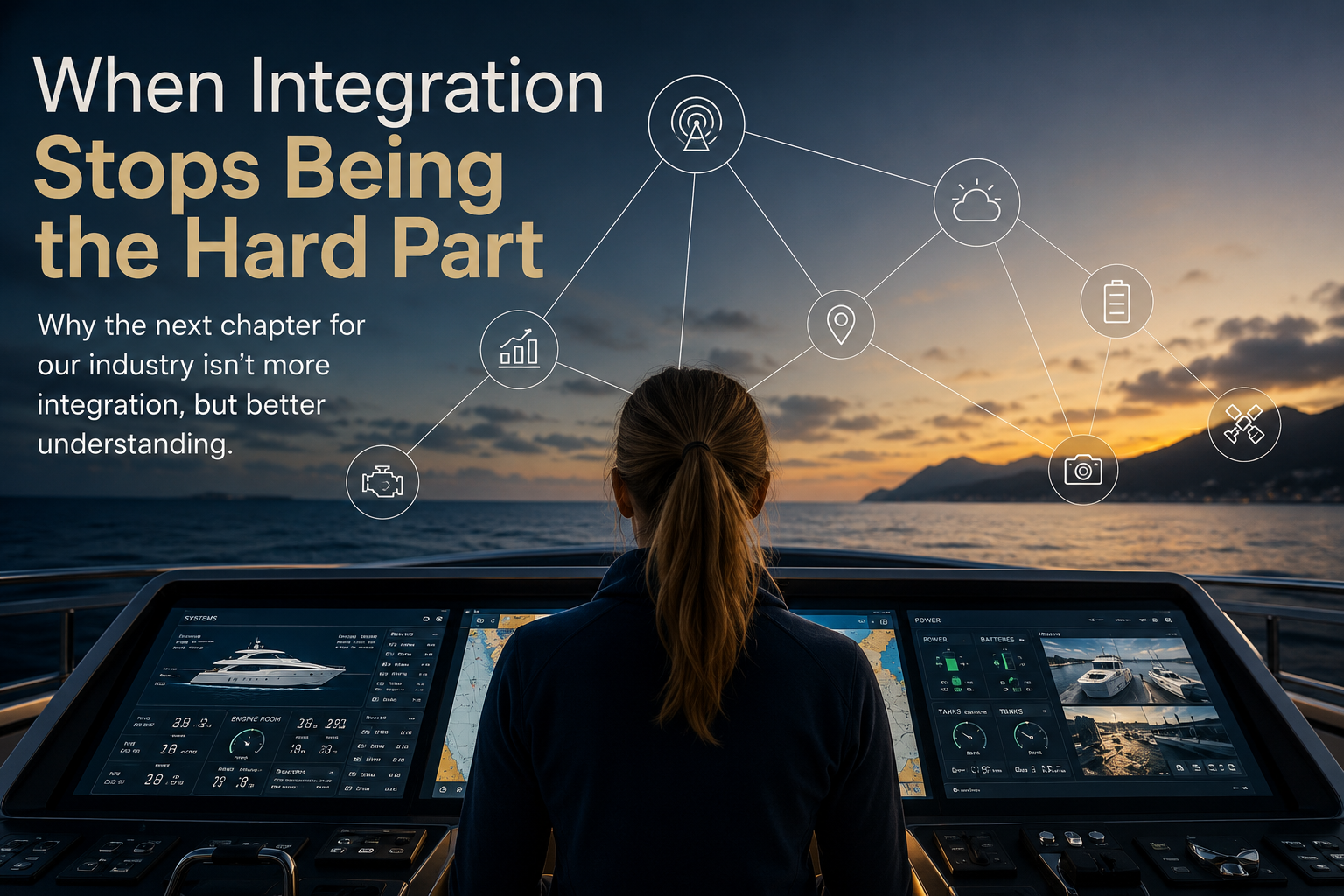
Modern boats are becoming incredibly good at generating information. An owner can see engine data, battery status, weather, navigation, cameras, AIS, maintenance records and dozens of other data sources.
That’s progress.
But information, on its own, doesn’t reduce workload.
Sometimes it increases it.
More screens.
More notifications.
More applications.
More decisions.
The real opportunity isn’t collecting more information.
It’s helping people understand the relationships between it.
An engine alarm means something different if you’re tied safely alongside than if you’re entering a narrow harbour in deteriorating weather. A battery warning means something different after three days at anchor than it does when you’re connected to shore power.
Context changes everything.
Looking back, I think we’ve been measuring progress by the wrong milestone.
We celebrated when systems could finally talk to one another.
That was an important achievement.
But perhaps it was never the destination.
Perhaps it was simply the foundation.
The harder problem isn’t building connected boats.
It’s building boats that help people understand what those connections mean.
That feels like the next chapter for our industry.
Not more devices.
Not more applications.
Not even more integration.
Better understanding.
Because in the end, the value of a connected boat isn’t that everything can communicate.
It’s that the people on board can make better decisions because of it.