
AI on Board: Decision Support, Not Autonomy
A recent support ticket reminded me how far we still have to go before AI becomes truly useful on boats.
One of our customers reported that a switching panel wasn’t displaying the correct state of several circuits. Sometimes a switch would appear on. A moment later it would appear off. Then it would correct itself again.
At first glance it looked like a software problem.
It wasn’t.
After digging into the network traffic, we discovered that three completely unrelated devices on the boat had all been left on the same factory-default instance. The switching system was reporting the correct information, but so were the other devices. The result was a stream of conflicting messages arriving from multiple sources, with the displayed state changing depending on which message arrived last.
The customer happened to be a pilot. When we explained the problem, he immediately understood.
“It sounds like a squawk code conflict,” he said.
Exactly.
The switching system wasn’t broken. The network wasn’t technically broken either. The data was simply ambiguous.
Now imagine asking an AI system to make decisions based on that information.
This is the part of the AI conversation that rarely gets discussed.
Whenever AI comes up in a marine discussion, the conversation usually turns to smarter routing, predictive maintenance, improved fuel efficiency, and better decision-making. None of those ideas are unrealistic. In fact, I believe all of them are possible.
The challenge is that most conversations start at the finish line.
Before AI can optimize a route, predict a failure, or recommend a course of action, somebody has to solve the data problem. On boats, that is often harder than people realize.
A modern vessel is not a single system. It is a collection of systems from different manufacturers, developed at different times, using different protocols and different assumptions about how information should be shared. Even when data is available, it is not always trustworthy.
Sensors fail. Devices get replaced. Networks are reconfigured and software updates change behavior. Boats evolve over time, often with equipment from multiple manufacturers added years apart. Every one of those changes introduces uncertainty.
The reality is that AI does not magically transform bad data into good decisions.
There is another challenge that may be even more important than data quality: trust.
A captain must believe the information before they can act on it. That trust is not built through impressive demonstrations or clever marketing. It is earned slowly through consistent, reliable performance over time.
Every sailor has experienced an instrument that was wrong, a sensor that failed, a chart that didn’t quite match reality, or a system that suddenly stopped behaving as expected. When that happens, trust is damaged. And once trust is damaged, people stop relying on the system.
The challenge for AI is no different.
Before a captain can trust a recommendation, they must trust the data behind it. Before they can trust the data, they must trust the systems collecting it. Before they can trust the systems, they must trust that the information is being presented accurately and in context.
Trust is built in layers.
A prediction is only as trustworthy as the foundation beneath it.
But solving the data problem is only half the challenge.
Let’s assume for a moment that we have perfect data.
Now what?
How should that information be presented?
Most discussions about AI focus on producing better insights. Far fewer focus on how those insights should be delivered to a human being.
A captain crossing an ocean does not need the same information as a captain entering a harbor. The priorities change. So does the way information should be presented.
The pilot who reported the switching issue understood this immediately. In aviation, presenting the right information at the right time is every bit as important as collecting it.
A system can generate hundreds of observations, predictions, warnings, and recommendations, but if they all compete for attention at the same time, the result is not intelligence.
It’s noise.
I believe the future of AI in the marine industry is decision support. Not because captains lack expertise, but because expertise works best when supported by the right information at the right time.
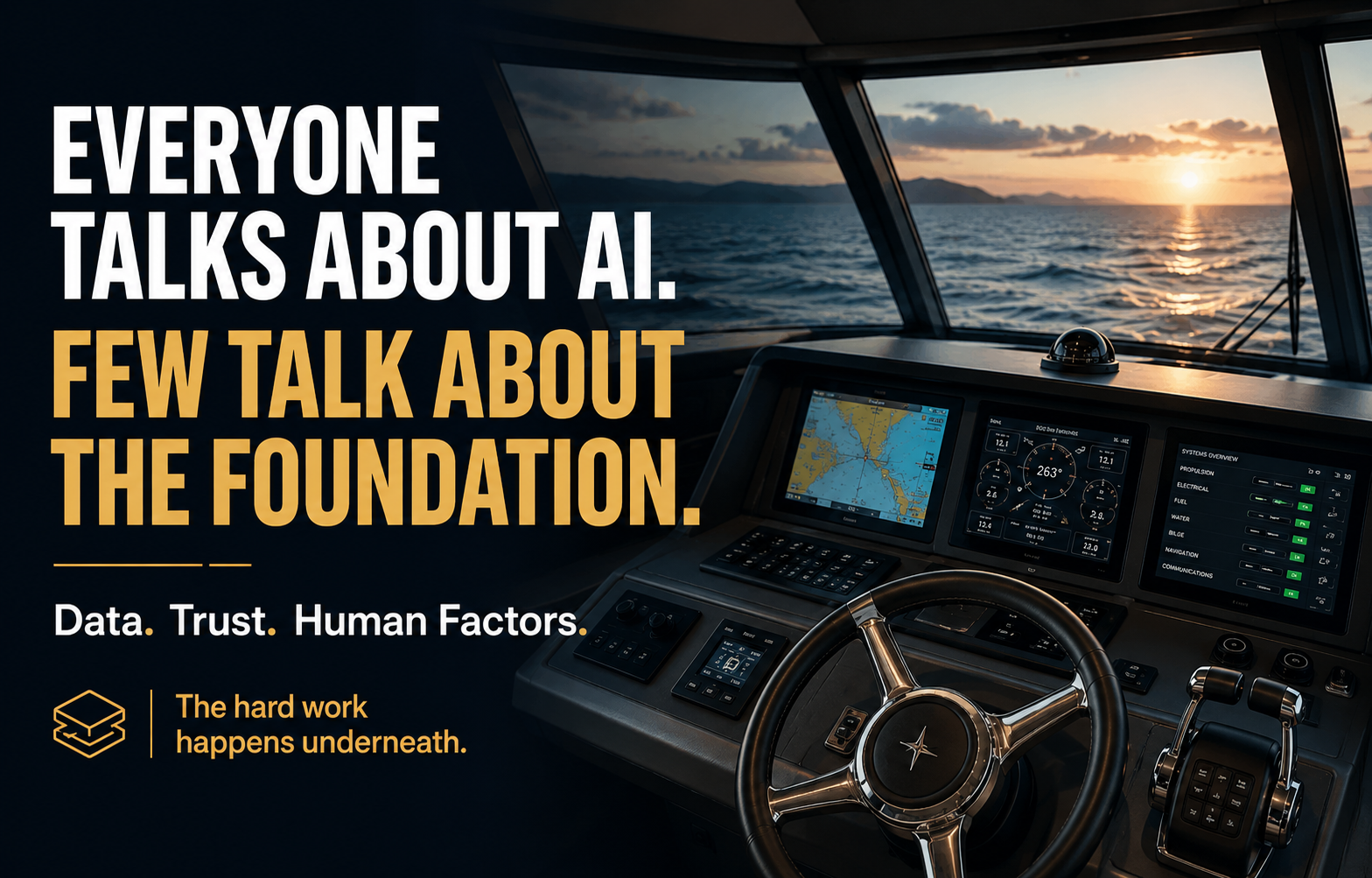
The work starts much earlier than most people think. It starts with reliable data, trust, human factors, and understanding how people actually make decisions under real-world conditions.
AI is not magic.
The hard work happens underneath.
And the companies that succeed will be the ones willing to do that work first.