
Understanding Changes Everything
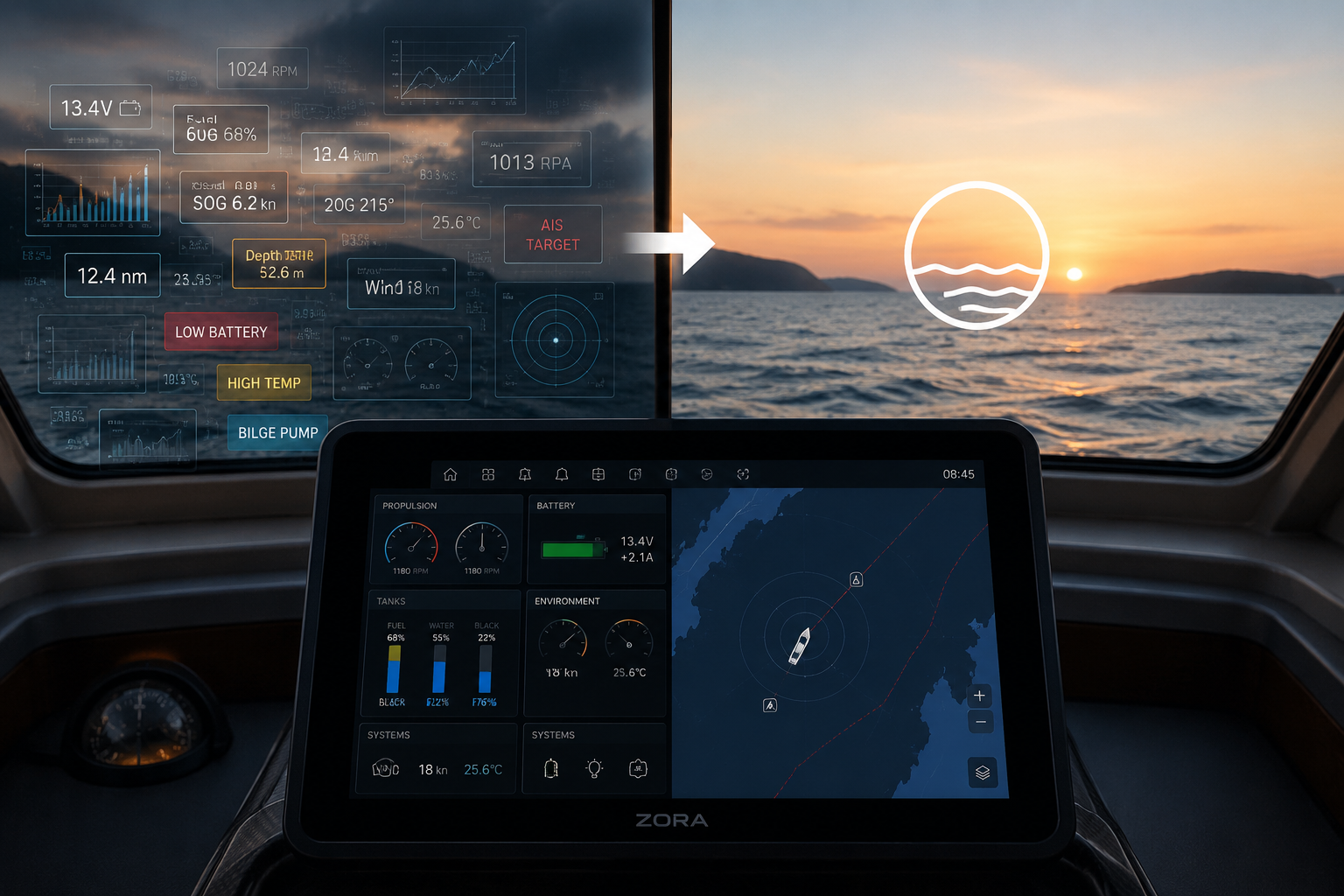
Why Situational Awareness Matters More Than Data
When we started building Zora, we weren’t trying to create another display.
The marine industry already has plenty of displays.
What we kept running into was a different problem.
Boats were generating more information than ever before, but captains were still spending an enormous amount of time trying to understand what that information meant.
A modern vessel can produce thousands of data points every second.
Engine temperatures.
Battery voltages.
Tank levels.
Wind data.
GPS positions.
AIS targets.
Weather information.
Pump activity.
System alarms.
The list keeps growing.
The challenge isn’t collecting the data.
The challenge is understanding what deserves your attention.
After years of living aboard and crossing oceans ourselves, we learned something important.
At any given moment, only a small fraction of the available information actually matters.
During a night approach, traffic and depth matter.
At anchor, changes in wind direction and vessel position matter.
Offshore, weather trends may matter more than almost anything else.
The problem is that most marine systems don’t understand context.
They display information.
They don’t help captains understand significance.
That’s the distinction we became interested in.
The difference between data and understanding.
Data tells you what is happening.
Understanding helps you decide what to do next.
That’s why we spent years building the foundation described in our previous article, “Why We Chose the Hard Path.”
Before a system can provide meaningful insight, it first needs to understand the boat.
Not an idealized boat.
Not a laboratory test environment.
A real boat with real equipment, real history, and real operating patterns.
Only then can something more interesting happen.
Patterns begin to emerge.
A battery bank starts behaving differently than normal.
A pump begins cycling more frequently than it did last month.
Fuel consumption slowly changes over time.
None of these changes may trigger traditional alarms.
Yet together they may tell an important story.
This is where intelligent systems become valuable.
Not because they replace the captain.
Not because they automate decision-making.
But because they help surface information that might otherwise remain hidden inside thousands of individual data points.
The goal isn’t more alerts.
The goal is better awareness.
Not more information.
Better understanding.
We believe this is where the future of marine technology is heading.
The industry has become exceptionally good at collecting information.
The next challenge is helping people understand what matters.