
Why We Chose the Hard Path
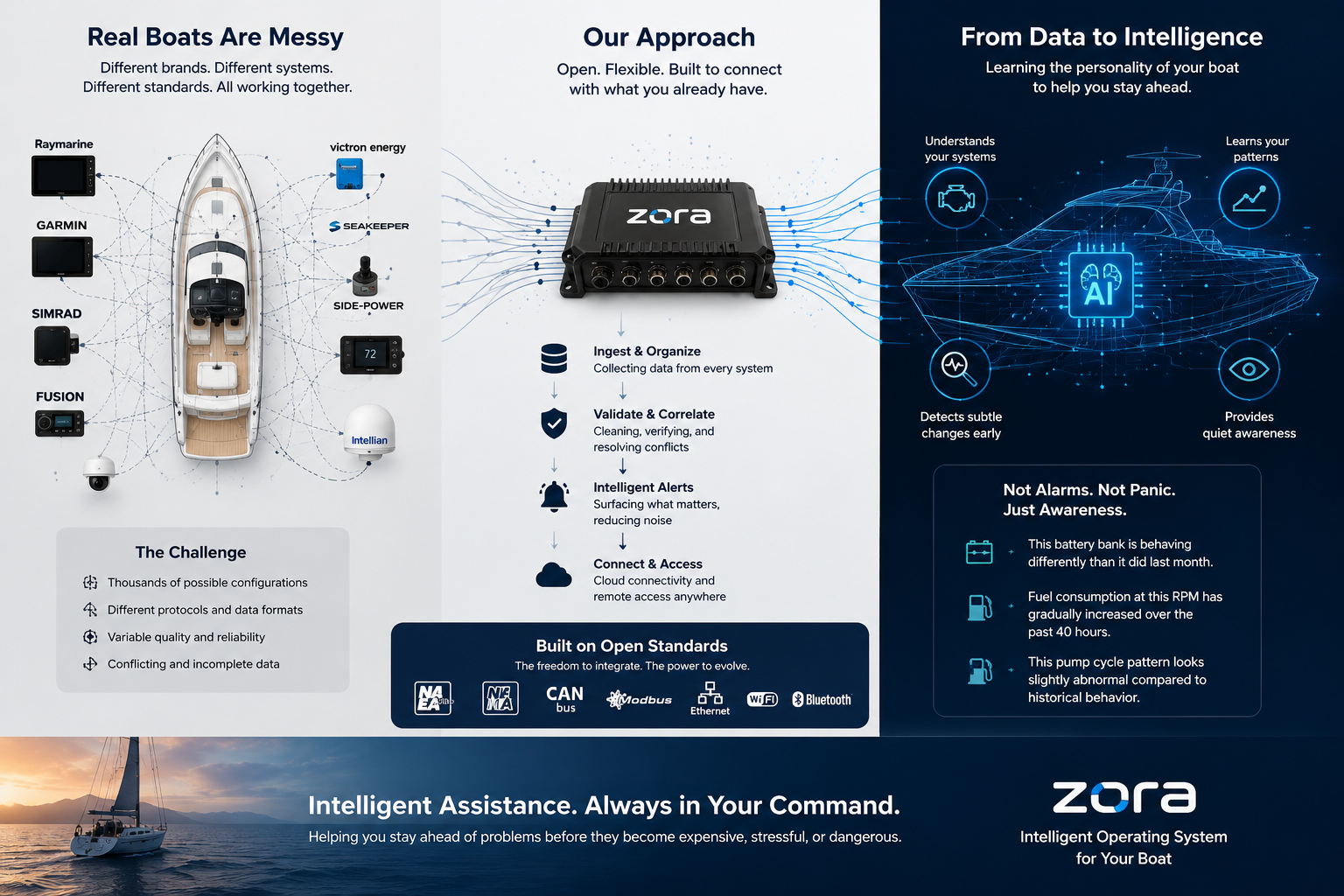
When we started building Zora, we made a decision that, honestly, probably added years to the journey.
We decided Zora needed to work with real boats.
Not ideal boats.
Not controlled environments.
Not a single manufacturer’s ecosystem.
Real boats.
And real boats are messy.
Over time, boats evolve. Owners upgrade systems. New technology gets added beside legacy technology. Different brands, different standards, different generations of equipment all end up living together onboard.
A radar from one company.
An autopilot from another.
A battery system from somewhere else.
Three different apps trying to solve three different problems.
Individually, most of it works.
But nobody was connecting the dots.
That became the problem we wanted to solve.
Not by forcing owners to rip everything out and start over.
But by building something open enough to work with what they already had onboard.
That sounds straightforward until you actually try to do it.
Because once you step into the real world of marine electronics, you quickly realize there aren’t just dozens of possible configurations.
There are thousands.
Different protocols.
Different network behaviors.
Different interpretations of standards.
Different quality of data.
And every boat tells a slightly different story.
That’s why building Zora has taken time.
The hard part was never drawing beautiful screens.
The hard part was teaching the system how to understand what was happening onboard across an almost endless combination of technologies and installations.
Step one was simply ingesting and organizing the data.
Then came validation.
What data is trustworthy?
What data conflicts?
What matters right now?
What deserves the captain’s attention?
That’s where our rules-based intelligence started.
We wanted Zora to do more than display information. We wanted it to help captains understand what was important.
That led to intelligent alerts, alarms, cloud connectivity, remote access, and situational awareness tools designed to reduce overload instead of adding to it.
But in many ways, that was only the foundation.
Because once you can reliably ingest, organize, and understand the data coming from a boat, something much more interesting becomes possible.
Learning.
Every boat has patterns.
How it normally behaves.
How the owner operates it.
What “healthy” looks like.
What changes before a problem occurs.
Over time, Zora can begin learning the personality of the boat itself.
Not just generic thresholds.
Your boat.
Your engines.
Your electrical system.
Your usage patterns.
Your cruising style.
That’s where machine learning starts becoming powerful.
Not because AI is taking over the boat.
But because the system can begin recognizing subtle changes humans would struggle to notice across thousands of data points over long periods of time.
Imagine your boat quietly noticing:
“This battery bank is behaving differently than it did last month.”
Or:
“Fuel consumption at this RPM has gradually increased over the past 40 hours.”
Or even:
“This pump cycle pattern looks slightly abnormal compared to historical behavior.”
Not alarms.
Not panic.
Just awareness.
That’s the direction we believe intelligent boating systems will evolve.
Not replacing captains.
Not removing the human element from boating.
But helping people stay ahead of problems before they become stressful, expensive, or dangerous.
And none of that works without openness.
Because intelligence is only as good as the information it can see.
That’s why we chose the hard path years ago.
And looking back now, we’re glad we did.