
The Most Important Work in Maritime AI Isn’t AI
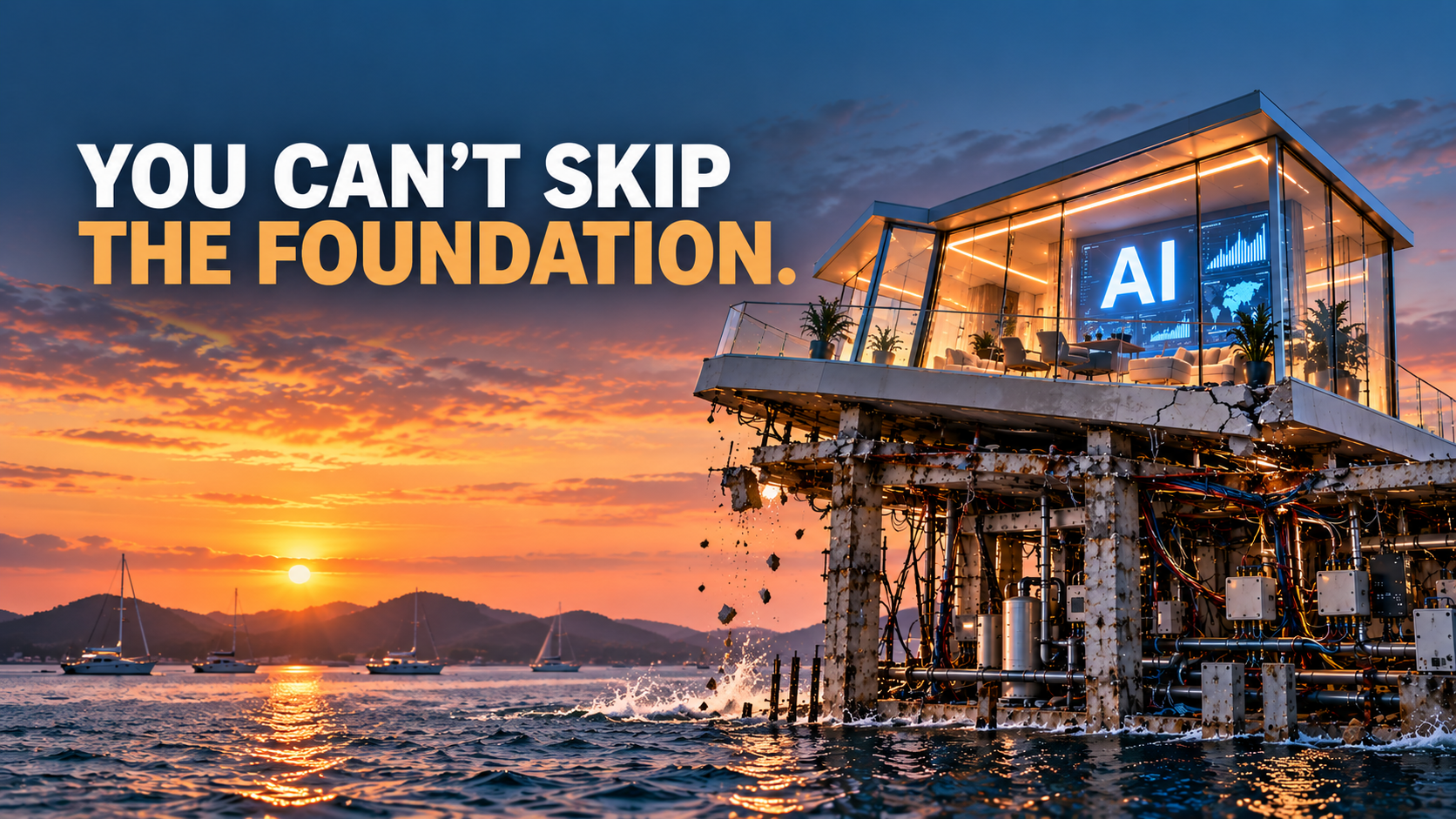
AI is everywhere in maritime right now.
AI for navigation. AI for maintenance. AI for routing. AI for energy management. AI for vessel operations.
Apparently, if we say AI often enough, eventually the vessel becomes intelligent. :)
I don’t believe that.
Not because I don’t believe in AI. I absolutely do.
I just don’t believe in magic.
And sometimes I wonder whether, in our excitement about what AI might eventually do, we’re investing in the penthouse before we’ve finished building the foundation.
I’ve spent years working with data coming from real boats.
It is messy.
Sensors can be wrong.
Two devices can report different values for what appears to be the same thing.
Equipment gets replaced.
Configurations change.
Calibration matters.
Data disappears.
Networks behave badly.
And a value can be completely accurate and still be almost meaningless if you don’t know what the boat was doing when it was recorded.
An oil pressure reading tells you something.
Oil pressure at a particular RPM, engine temperature and load, compared with thousands of previous observations from that particular engine, tells you considerably more.
Wind speed tells you something.
Wind speed combined with wind angle, sail configuration, reefing, sea state, boat speed and the historical performance of that particular boat tells you something very different.
The intelligence isn’t hiding in another dashboard.
It’s in the relationships.
And building those relationships requires a lot of decidedly unsexy work.
Connecting systems from different manufacturers and generations.
Figuring out which data can be trusted.
Validating and calibrating sensors.
Normalizing information coming from completely different systems.
Understanding what a value means in the context of everything else happening onboard.
Preserving enough history to eventually understand what “normal” actually looks like.
We’ve spent years doing this work.
It isn’t the part anyone calls AI.
But without it, I’m not sure how much of the AI we’re all talking about can deliver what is being promised.
A model can find patterns in data extraordinarily well.
But if the temperature sensor is wrong, the engine RPM came from the wrong source, two devices are reporting the same information, the battery configuration changed six months ago, or the system doesn’t know whether the boat was motoring, sailing, charging or sitting at anchor, a more sophisticated algorithm doesn’t fix the problem.
It may simply become more confident about the wrong answer.
And there is another problem.
Maritime already has plenty of intelligent systems.
Navigation has its intelligence.
Engines have theirs.
Power systems have theirs.
Weather has its own.
Maintenance systems, cameras, communications and automation increasingly have theirs too.
So what happens if we simply add AI independently to every one of them?
Do we get an intelligent vessel?
Or do we get smarter silos?
Because someone still has to understand what all of those individually intelligent systems are saying together.
And too often that someone is still the human onboard.
I don’t think the real opportunity is making every piece of equipment smarter.
I think it is creating an operating environment capable of understanding the relationships between them.
What is happening now?
What was happening the last time this occurred?
What is normal for this particular vessel?
What has changed?
What else changed at the same time?
Which other systems are affected?
And what does all of that mean in the context of what the vessel is actually doing?
Only then do we arrive at the question everyone seems determined to start with:
What should we do about it?
That’s where I think AI becomes extraordinarily interesting.
Finding relationships a human might miss.
Recognizing subtle changes across millions of observations.
Prediction.
Decision support.
And eventually helping coordinate actions across systems rather than simply making each system individually smarter.
There is a lot of investment chasing maritime AI right now, and I understand why.
The possibilities really are exciting.
But perhaps some of the most valuable technology being built today isn’t the technology shouting the loudest about AI.
It may be the technology doing the quiet work underneath it.
Connecting.
Validating.
Calibrating.
Remembering.
Establishing context.
Learning what can be trusted.
Building the foundation.
I wrote before that AI is not magic.
I believe that more strongly now.
AI can do extraordinary things once it has a trustworthy understanding of the operating environment.
But it cannot manufacture that understanding simply because we give it more data.
AI isn’t the foundation.
It’s what becomes useful once the foundation is there.