
Why Airline Pilots and Software Engineers Instantly “Get” Zora
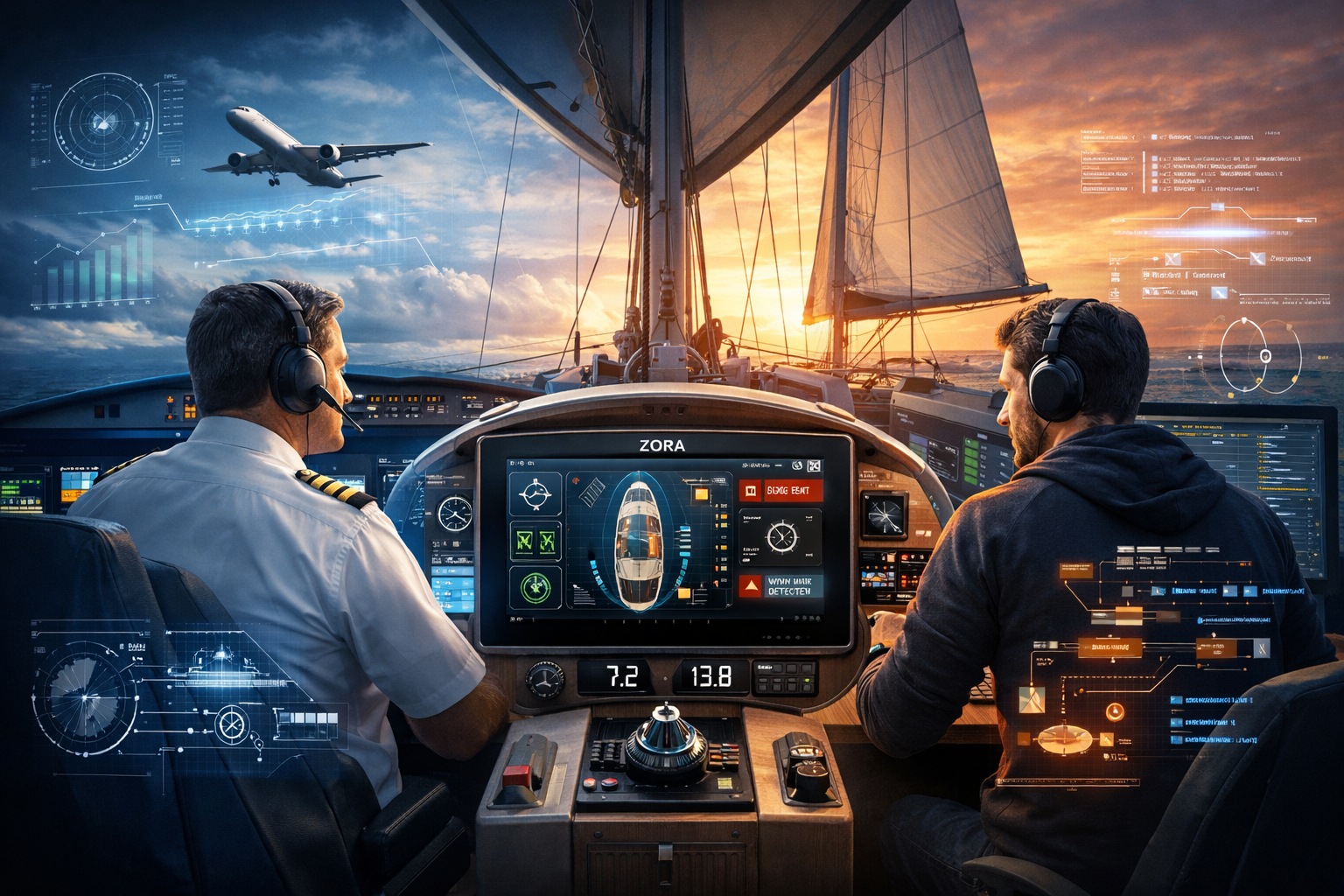
As Zora has found its way onto more and more yachts, we’ve started to notice an unexpected and fascinating pattern.
A disproportionate number of our newest customers are airline pilots and software engineers—often people who are also passionate sailors.
At first, this surprised us. Then it made complete sense.
Because these two groups share something fundamental: they are deeply fluent in complex, safety-critical systems—and they immediately recognize one when they see it.
Pilots Understand Systems, Not Screens
Modern aircraft are not flown by chasing gauges or juggling disconnected instruments. They are flown by integrated flight systems that:
Collect data from hundreds of sensors
Validate and prioritize that data
Present it in a way that supports human decision-making
Automate where appropriate, but always keep the pilot in command
Airline pilots are trained to think in terms of system states, failure modes, redundancy, and situational awareness. They don’t want more information—they want the right information, at the right time, in the right context.
When pilots see Zora, they don’t see “another chartplotter.”
They see:
A data aggregation layer
A rules-based decision engine
A human-centric interface designed to reduce cognitive load
An architecture built around resilience and fault tolerance
In other words: they see a flight system for boats.
And that’s why they “get it” instantly.
Software Engineers See the Architecture
Software engineers—especially those who sail—often have an even more visceral reaction.
They recognize the problem immediately:
Fragmented apps
Closed ecosystems
Data silos
Brittle integrations
Interfaces that scale poorly as complexity increases
They’ve lived this problem before—in enterprise software, infrastructure, and distributed systems.
So when they encounter Zora, what excites them isn’t just what it does—but how it’s built.
They see:
An open, multi-protocol architecture
A clean separation between data collection, validation, logic, and presentation
A system designed to evolve over time, not be replaced every few years
A platform that treats the boat as a living system, not a bundle of isolated products
Many of them tell us the same thing, almost word for word:
“I’ve been waiting for someone to do this properly.”
Sailors Who Think in Systems Sail Differently
Both pilots and engineers share another trait:
they are comfortable operating in environments where mistakes are expensive.
They value:
Predictability over novelty
Signal over noise
Automation that supports—not replaces—human judgment
When they sail, they don’t want to babysit equipment.
They want confidence that the system is watching with them.
Zora resonates with these sailors because it:
Connects everything, instead of forcing trade-offs
Surfaces emerging issues before they become problems
Maintains a coherent mental model of the vessel at all times
Continues to function even when parts of the system fail
This is exactly how modern aviation and mission-critical software systems are designed.
What This Tells Us About the Future of Marine Technology
This pattern has reinforced something we’ve believed from the beginning:
The future of marine technology isn’t about better gadgets.
It’s about better systems.
As boats become more complex—hybrid propulsion, advanced energy systems, automation, remote monitoring—the industry can’t rely on disconnected tools and proprietary silos anymore.
Pilots and software engineers are simply early indicators.
They recognize what Zora represents because they’ve already seen where fragmented systems lead—and what replaces them.
Zora Isn’t for Everyone (Yet)
And that’s okay.
Zora isn’t designed to impress at first glance with flashy screens or novelty features. It’s designed to earn trust over time.
But for those who live and work inside complex systems—who understand risk, integration, and situational awareness—Zora feels immediately familiar.
Not because it looks like aviation or enterprise software…
…but because it thinks like it.
A Founder’s Perspective
When we started building Zora, we weren’t trying to reinvent chartplotters or compete feature-by-feature with existing marine electronics. We were trying to solve a deeper problem we had lived ourselves:
Boats had become complex systems, but the software running them hadn’t evolved accordingly.
After years at sea, dealing with growing layers of equipment, apps, sensors, and workarounds, it became clear that the industry was missing something fundamental—an operating system that understood the boat as a whole. One that could collect data from everything onboard, make sense of it, and support the captain with clarity rather than noise.
So when airline pilots look at Zora and immediately understand what it is, that feels deeply validating. They recognize the architecture. They recognize the philosophy. They recognize the focus on situational awareness, redundancy, and human decision-making.
And when software engineers react with genuine excitement—not because of a single feature, but because of how the system is designed—that tells us we’re on the right path.
These customers aren’t buying Zora because it’s trendy or new.
They’re buying it because it feels inevitable.
They see what happens when systems scale without structure—and they also know what good system design looks like when it’s done properly.
Zora is the product of that belief:
That boats deserve the same level of thoughtful, resilient, system-level design as aircraft and mission-critical software.
The fact that pilots and engineers “get it” right away doesn’t surprise us anymore.
It reassures us.