
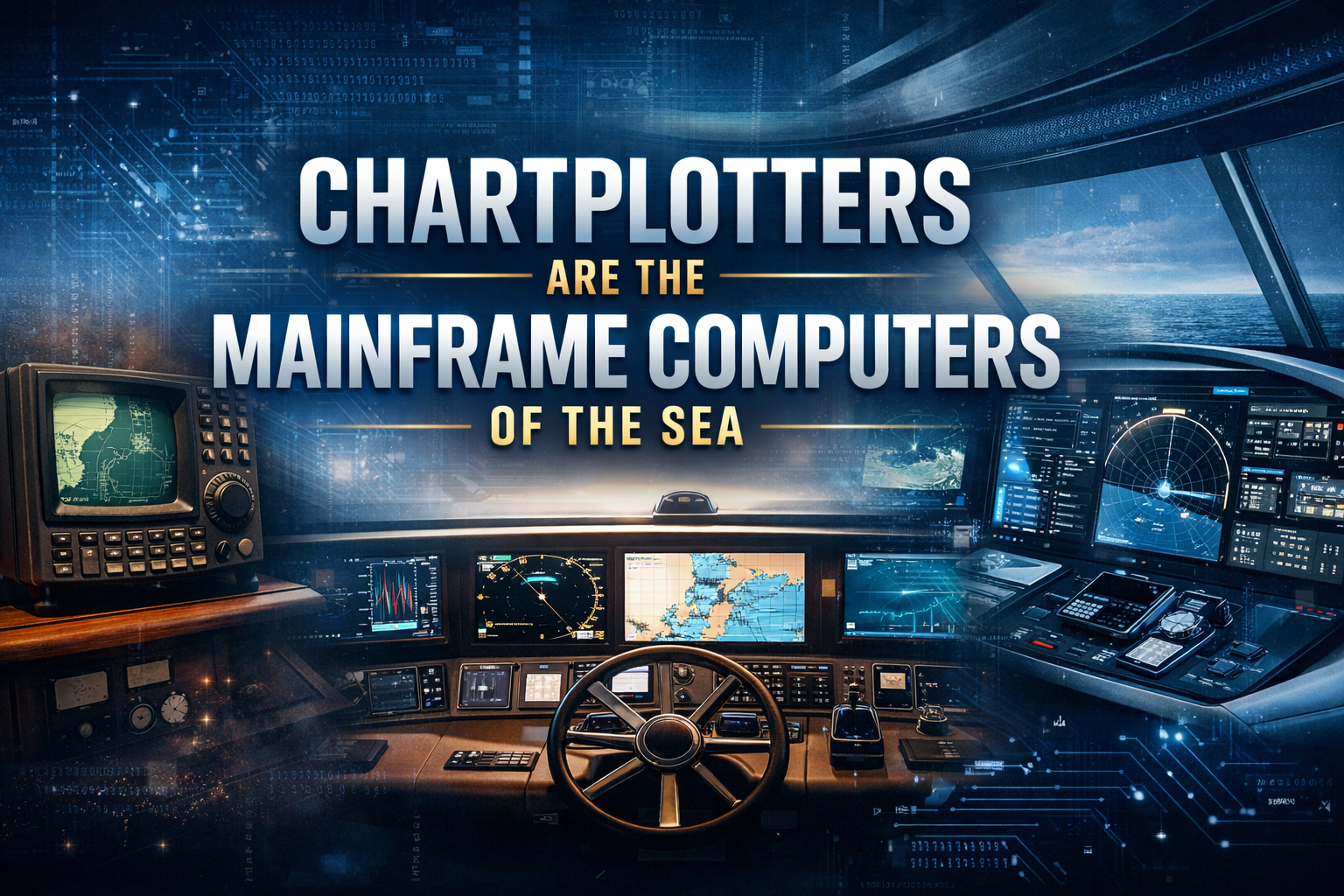
For decades, chartplotters have been the unquestioned center of the yacht helm. They’ve grown bigger screens, faster processors, and nicer graphics—but at their core, they haven’t changed.
That’s not evolution.
That’s preservation.
Chartplotters today are what mainframe computers were to enterprise IT in the 1970s and 80s: powerful for their time, mission-critical, deeply entrenched—and fundamentally constrained by the era in which they were designed.
This isn’t an insult.
It’s a reality check.
Mainframes Didn’t Fail — They Were Outgrown
Mainframes weren’t replaced because they were unreliable. They were replaced because the world around them changed.
They assumed:
One central computer
One dominant interface
One vendor controlling the ecosystem
One way of working
As businesses became more complex, more connected, and more data-driven, those assumptions broke down. The answer wasn’t “better mainframes.” It was entirely new architectures: distributed systems, open protocols, and software-first platforms.
Sound familiar?
The Helm Is Now a System — But We’re Treating It Like a Device
Modern yachts are no longer simple machines. Even modest cruising boats now operate as complex, interconnected systems:
Navigation
Engines
Power generation and storage
Tanks and pumps
Climate
Safety systems
Communications
Weather and routing
Logs, compliance, and maintenance
Yet we’re still trying to manage all of this through devices designed to draw charts.
So we bolt things on:
Another screen
Another app
Another overlay
Another alarm
The result isn’t clarity.
It’s fragmentation.
You don’t modernize a mainframe by adding apps.
Why This Matters: Safety, Cognitive Load, and Decision-Making
At sea, technology doesn’t fail only when it breaks.
It fails when it overwhelms.
Alarm fatigue.
Conflicting data.
Multiple interfaces telling different stories.
Critical information buried under non-critical noise.
In aviation, this problem was solved decades ago. Not by louder alerts—but by situational awareness. Systems that understand context, prioritize information, and support human decision-making instead of competing for attention.
Marine leisure deserves the same standard.
If your system needs to shout, it already failed.
The Industry’s Mistake: Confusing Integration with Architecture
Much of the marine industry talks about “integration.”
What they usually mean is connection.
Connecting systems is not the same as designing a system.
When every component still thinks it’s the center of the universe, you don’t get a unified experience—you get a collection of opinions fighting for screen space.
True architecture starts with a different question:
What is the boat trying to do right now—and what does the captain actually need to know?
That’s not a charting problem.
That’s a systems problem.
Why We Built Zora the Way We Did
When we started iNav4U, we made a deliberate choice:
We were not going to build a better chartplotter.
We were going to build a marine operating system.
One that:
Treats the yacht as a living system, not a set of gadgets
Is software-first, not hardware-locked
Uses open protocols instead of vendor lock-in
Prioritizes context over raw data
Works across screens, devices, and future technologies
This choice was harder. Slower. Less familiar.
But it’s the only path that makes sense if you’re building not for the next boat show—but for the next 30 years of boating.
This Is an Inflection Point
Every mature industry hits a moment where incremental improvement stops being enough.
Enterprise IT hit it.
Aviation hit it.
Automotive is in the middle of it now.
Marine leisure is next.
Chartplotters won’t disappear overnight—mainframes didn’t either. But their role will change. They will no longer be the system. They’ll become one component in a broader, software-defined architecture.
That shift isn’t about replacing products.
It’s about rethinking the foundation.
Our Commitment
At iNav4U, we believe boaters deserve technology that:
Reduces workload instead of adding to it
Grows with their vessel over decades
Respects their freedom to choose
Brings enterprise-grade thinking to the helm
This isn’t about disruption for disruption’s sake.
It’s about leadership—saying clearly when an old model no longer serves the future.
If chartplotters were invented today, they would never look like this.
And that’s why we’re building what comes next.