
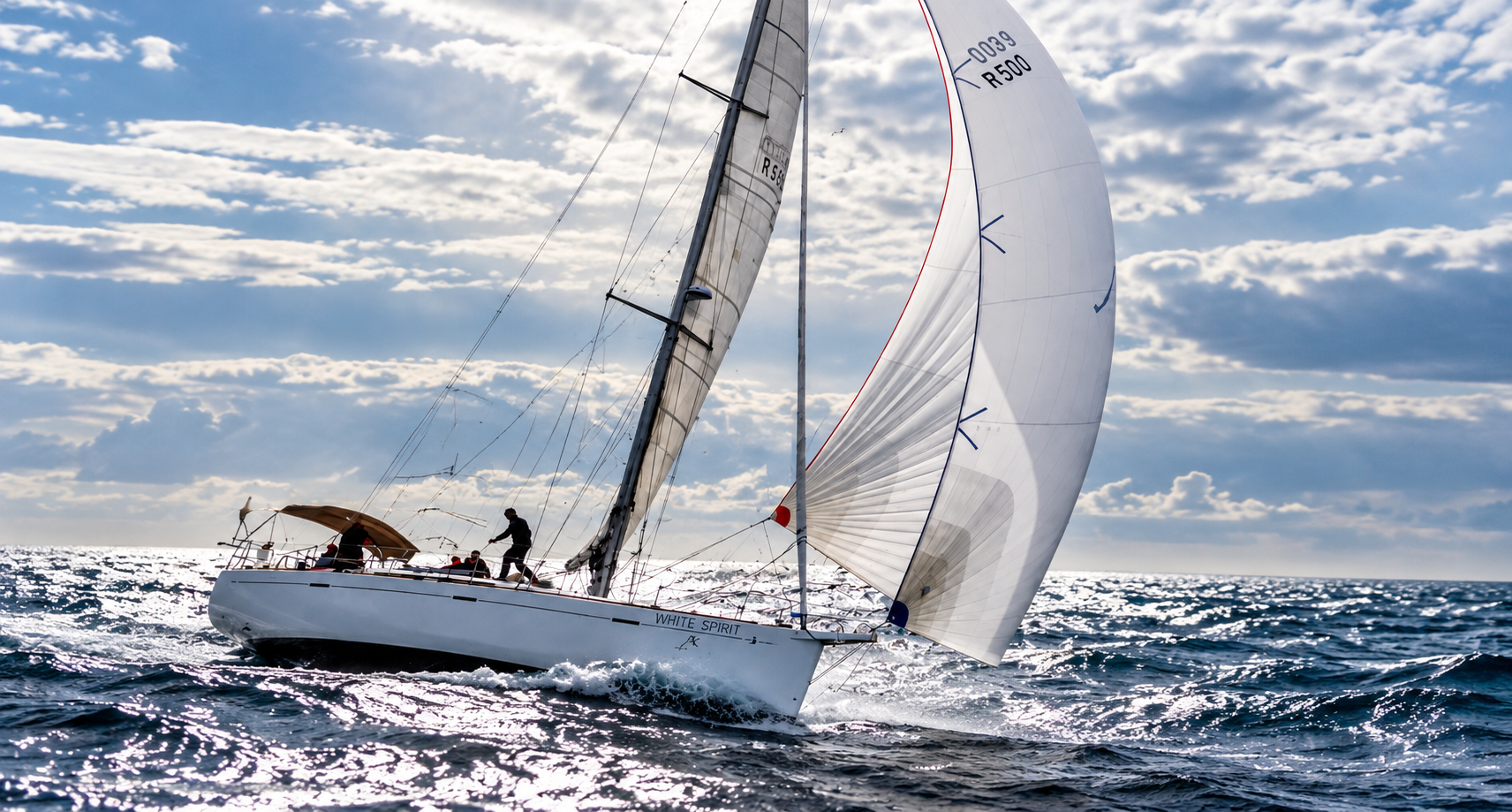
White Spirit
Expedition. Adrena. B&G. Garmin. Raymarine.
These are names that sailors know and respect. They’ve helped shape modern navigation, offshore racing and sailing performance.
We’re not here to diminish what they’ve accomplished.
But after nine years of building Zora, we believe there’s a fundamentally different way to approach navigation and sailing performance.
What if, instead of constantly telling the boat what she’s capable of, we let the boat tell us?
That’s the thinking behind Zora.
And now we’re putting it to the test in one of the most demanding environments we could choose: offshore racing.
Meet White Spirit
White Spirit is a Beneteau First 50 owned by Cyrus Allen, Commodore of the Ocean Racing Club of Victoria (ORCV) in Australia.
With the support of our Australian partner, Vanti Technology, Zora has been installed aboard White Spirit for her offshore racing campaign, beginning with the Bass Strait Cup.
This isn’t a carefully controlled demonstration in a marina.
White Spirit is racing with a real crew, in changing weather, with all the challenges that offshore sailing brings.
And we’re following along from Nova Scotia, Canada, with remote access to Zora and a front-row seat to what happens when our technology meets the real world.
What Makes Zora Different?
Traditional racing navigation relies on a combination of instruments, performance data, weather forecasts and routing software.
These tools can be extraordinarily sophisticated. But much of the work of connecting the information, interpreting it and deciding what matters still falls to the navigator.
Zora approaches the problem differently.
She’s an operating system for the boat.
She brings navigation, instruments, weather, performance and onboard systems together into a common environment.
And rather than relying exclusively on a predefined performance model, Zora is being developed to learn from the boat’s actual behaviour.
How fast does she really sail in these conditions? How does her performance change with the wind? How closely does reality match the forecast and the predicted route?
The goal is to build an increasingly accurate understanding of the individual boat, not simply the theoretical performance of her design.
Let the boat tell us what she’s actually capable of.
The Ocean Is Already Teaching Us
We’re only at the beginning of White Spirit’s racing campaign, and we’re already learning.
During the Bass Strait Cup, White Spirit experienced an unexpected power outage that took Zora offline.
The crew restored power and got her running again.
Zora can reload her last saved weather route from local storage, so the crew has that route available while she performs a new calculation.
But we discovered an opportunity to make the recovery process smarter.
After an unexpected shutdown, Zora should automatically check her weather data and initiate a fresh routing calculation.
This time, our team connected remotely from Canada and triggered the update.
Now we’re coding that improvement while White Spirit continues racing.
Once she finishes, we’ll deliver the changes through an over-the-air software update.
That’s one lesson.
Here’s another.
At approximately 1 AM aboard White Spirit, we observed the helmsman adjusting Zora’s display brightness.
Automatic brightness was enabled, but he wanted the screen darker.
He reduced it to just 5%.
A small interaction, perhaps. But an important one.
We’re capturing how the crew interacts with Zora during the campaign. That gives us insight into what they’re adjusting, which controls they’re using and where the experience could be improved.
It reminds us that intelligent marine technology isn’t just about sophisticated algorithms.
It’s also about a tired helmsman, in a dark cockpit, needing the right information without compromising his night vision.
The boat is teaching us about performance. The crew is teaching us about usability. And we’re turning those lessons into software.
Weather Routing That Meets Reality
One of the capabilities we’re particularly excited to test is Zora’s weather routing.
Weather forecasts are predictions. Boats operate in reality.
The challenge is to bring those two worlds closer together.
Zora combines forecast conditions with navigation and vessel-performance information to calculate routes. Our longer-term vision goes further: continuously comparing predicted conditions and performance with what the boat is actually experiencing, then using that knowledge to improve future recommendations.
During White Spirit’s campaign, we can compare the weather routes Zora calculates with the boat’s actual progress.
We’re learning how the system performs, where it needs refinement and what information is most useful to the crew.
We’re not claiming to have perfected offshore weather routing.
We’re putting our approach to the test, in public, and sharing what we discover.
Why We’re Sharing the Imperfections
It would be easy to publish only the beautiful screenshots, successful manoeuvres and impressive sailing speeds.
But that wouldn’t tell the whole story.
We’re a small Canadian team taking on a challenge that has attracted some of the most established names in marine technology.
We don’t have their resources, their distribution networks or their decades of market recognition.
What we do have is nine years of development, a different architectural approach and the willingness to learn directly from the people using our technology.
And because Zora is built around software, the lessons we learn can become improvements delivered to boats through over-the-air updates.
That creates a different relationship between the boat, the sailor and the people building the technology.
We’re not simply delivering a product and walking away.
We’re learning together.
A Different Future for Racing Navigation?
We believe the next important step in marine technology isn’t another isolated display or another standalone application.
It’s connecting the information already available aboard a boat, understanding its operational context and helping sailors make better-informed decisions.
For racing sailors, that means bringing together the boat’s actual performance, the weather, the route and the decisions being made onboard.
For cruising sailors, the same foundation can support safer, simpler and more informed passages.
The technology will continue to evolve. So will Zora.
And White Spirit is helping us understand what that evolution needs to look like.
We’re going to keep sharing what works, what doesn’t and what we learn along the way.
Because after nine years of building Zora, we believe it’s time to challenge some established thinking.
The established players have spent decades helping navigators understand their boats.
We want to find out what happens when the boat begins to understand herself.
Let the boat tell us what she’s capable of.
And let the racing begin. ⛵
Follow White Spirit’s offshore racing campaign and the continuing development of Zora OS at iNav4U.