
The Chartplotter Is Dead. Long Live the Yacht Operating System.
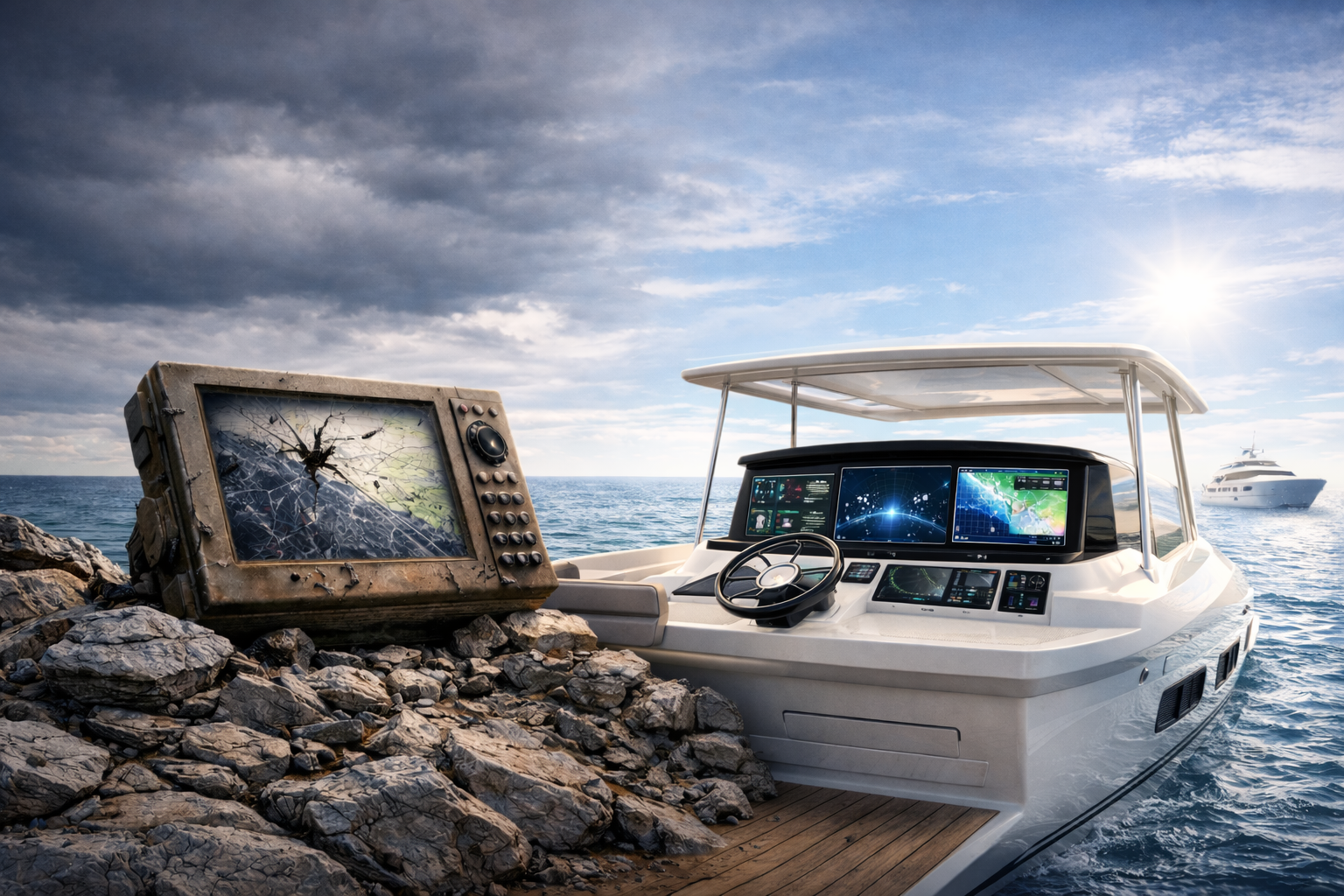
For decades, the chartplotter has been the unquestioned center of marine electronics.
It started as a breakthrough: digital charts, GPS, radar overlays. A single screen that replaced paper charts and reduced uncertainty at sea. For its time, it was revolutionary.
But here’s the uncomfortable truth:
The chartplotter didn’t evolve. It just accumulated features.
And today, it’s holding the industry back.
The Problem Isn’t Capability. It’s Architecture.
Modern yachts are floating systems-of-systems.
They generate enormous amounts of data:
Navigation
Engines
Electrical systems
Batteries and energy flows
Weather
AIS and collision data
Alarms, faults, and warnings
Logs, maintenance, documents, and history
Yet most yachts still “manage” this complexity using:
Multiple screens
Disconnected apps
Vendor-specific boxes
Alarms that scream without context
Data that exists… but isn’t understood
The chartplotter was never designed to think.
It was designed to display.
So manufacturers kept adding:
Another page
Another overlay
Another menu
Another app
The result? Information overload, not situational awareness.
Accumulation Is Not Intelligence
A bigger screen doesn’t make a smarter system.
More data doesn’t make better decisions.
And more alarms don’t make a safer boat.
In aviation, this lesson was learned decades ago. Pilots aren’t shown everything all the time. They’re shown what matters, when it matters, with systems designed to reduce cognitive load under stress.
Yachts deserve the same respect.
But the chartplotter model can’t get us there — because it treats everything as a feature, not part of a coherent system.
The Shift Has Already Happened in Every Other Industry
Look around.
Cars didn’t get better dashboards — they got operating systems.
Phones didn’t add buttons — they unified apps under one OS.
Homes didn’t add more switches — they became smart systems.
In every case, progress came when someone stepped back and asked:
“What if this wasn’t a device… but a platform?”
Marine electronics is the last major industry still pretending a single box can be the brain.
Enter the Yacht Operating System
A Yacht Operating System (Yacht OS) is not a chartplotter replacement.
It’s a fundamentally different way of thinking.
A Yacht OS:
Collects data from all onboard systems
Validates and prioritizes that data
Understands context (mode, conditions, history)
Presents information based on relevance, not availability
Supports decisions instead of demanding attention
Navigation becomes one part of a bigger picture — not the whole picture.
Weather talks to routing.
Engines talk to alarms.
Energy talks to autonomy.
History informs prediction.
This is how situational awareness is actually built.
Why This Matters to Captains
When things go wrong at sea, they rarely fail one system at a time.
Failures cascade.
Conditions change.
Fatigue sets in.
In those moments, the question isn’t:
“Do I have the data?”
It’s:
“Do I understand what’s happening right now — and what to do next?”
That’s not a chartplotter problem.
That’s an operating system problem.
The Chartplotter Isn’t Evil. It’s Just Finished.
Chartplotters will always have a place. Charts matter. Navigation matters.
But they are no longer — and should no longer pretend to be — the center of the yacht.
The future belongs to systems that:
Integrate instead of isolate
Think instead of display
Support humans instead of overwhelming them
The chartplotter had a great run.
Now it’s time for the Yacht Operating System.
Long live the Yacht OS.
At iNav4U, this belief is why we built Zora — not as another device, but as the brain of the modern yacht.