
Your Boat Isn’t One System. It Should Be.
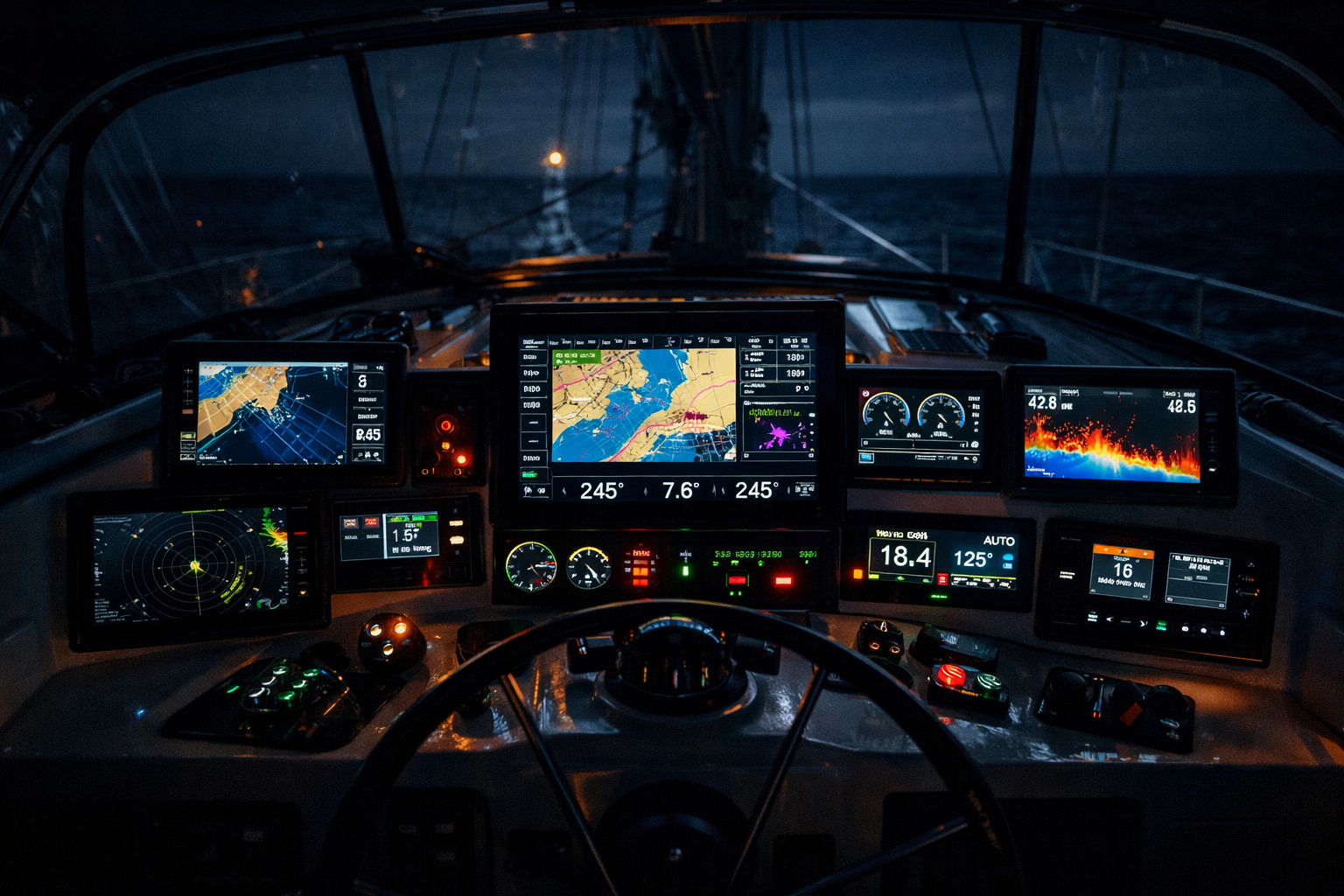
Stand at the helm for a moment.
Not at the dock.
Not during a demo.
But offshore. At night.
When it matters.
You’re watching the chartplotter.
Checking weather on another screen.
Glancing at engine data somewhere else.
Monitoring alarms. Adjusting course. Interpreting conditions.
And without even realizing it…
You’ve become the system.
The Hidden Truth Every Captain Lives With
Modern boats are incredible machines.
But the way we interact with them hasn’t kept up.
Instead of one cohesive system, most boats today are a collection of:
navigation devices
monitoring systems
apps
sensors
displays
All operating independently.
All demanding your attention.
All expecting you to connect the dots.
This Wasn’t Designed for You
It’s easy to assume this is just “how boats work.”
It’s not.
Marine systems weren’t designed to work together.
They were designed as individual products.
Over time, they became:
more advanced
more specialized
more expensive
But not more unified.
And so, quietly, the responsibility shifted…
From the system
👉 to the captain
The Cost No One Talks About
This isn’t just inconvenient.
It’s cognitive load.
At the exact moment when clarity matters most, you are:
switching between systems
interpreting fragmented data
prioritizing information manually
Not because you want to.
Because you have to.
And every experienced captain knows:
Complexity at sea is risk.
What a Helm Should Actually Feel Like
A helm should not feel like a control panel.
It should feel like clarity.
One place to understand what’s happening
One system that prioritizes what matters
One interface that supports your decisions
Not more screens.
Not more data.
Better awareness.
Because your boat is not a collection of systems.
It is one system.
The Industry Stopped Short
For decades, innovation in marine electronics has focused on:
faster processors
brighter screens
better charts
All valuable.
But none of it addressed the core problem:
👉 The lack of a unified system
So while technology improved…
The experience didn’t.
There Is a Better Way
Imagine this instead:
Your navigation, weather, engine, and onboard systems working together
Information prioritized automatically
Alerts that make sense in context
A system that adapts to how you operate
Not because you configured it perfectly.
But because it was designed that way from the start.
This Is the Shift
This isn’t about replacing one device with another.
It’s about replacing an entire way of thinking.
From:
fragmented tools
isolated data
reactive decision-making
To:
one system
connected intelligence
real situational awareness
Why We Built Zora
We didn’t start with technology.
We started with frustration.
Years at sea.
Real conditions.
Real limitations.
We learned to work around systems that didn’t work together.
Until one question became impossible to ignore:
Why are we still doing this?
So we built what we wished existed.
Not another device.
But an operating system.
What Zora Actually Is
Zora is not a chartplotter.
It is the system that sits above everything on your boat and brings it together.
Navigation
Systems monitoring
Alerts
Automation
Management
All in one intelligent interface.
Not replacing your boat.
Unlocking it.
This Is About More Than Technology
At sea, the goal isn’t to manage systems.
It’s to make decisions.
Confidently.
Clearly.
At the right time.
Everything else should support that.
The Question That Matters
Next time you’re at the helm, ask yourself:
Is your boat working as one system…
or are you working as the system?
Closing
For decades, we’ve accepted fragmentation as normal.
It isn’t.
And it doesn’t have to be.